Friday, October 30, 2015


Dryland Garden

The word "garden" conjures images of lush green plants and flourishing varieties of thick vegetation. So when one stumbles across a "dryland garden" a bit of confusion ensues.

Regions that are hot and prone to drought are best served by dryland or xeriscaping. This technique is about creating a cohesive and balanced landscape using low water plant species, native adapted plants, and water saving materials to capitalize on the benefits of an arid climate.


Thursday, October 29, 2015


One for the River

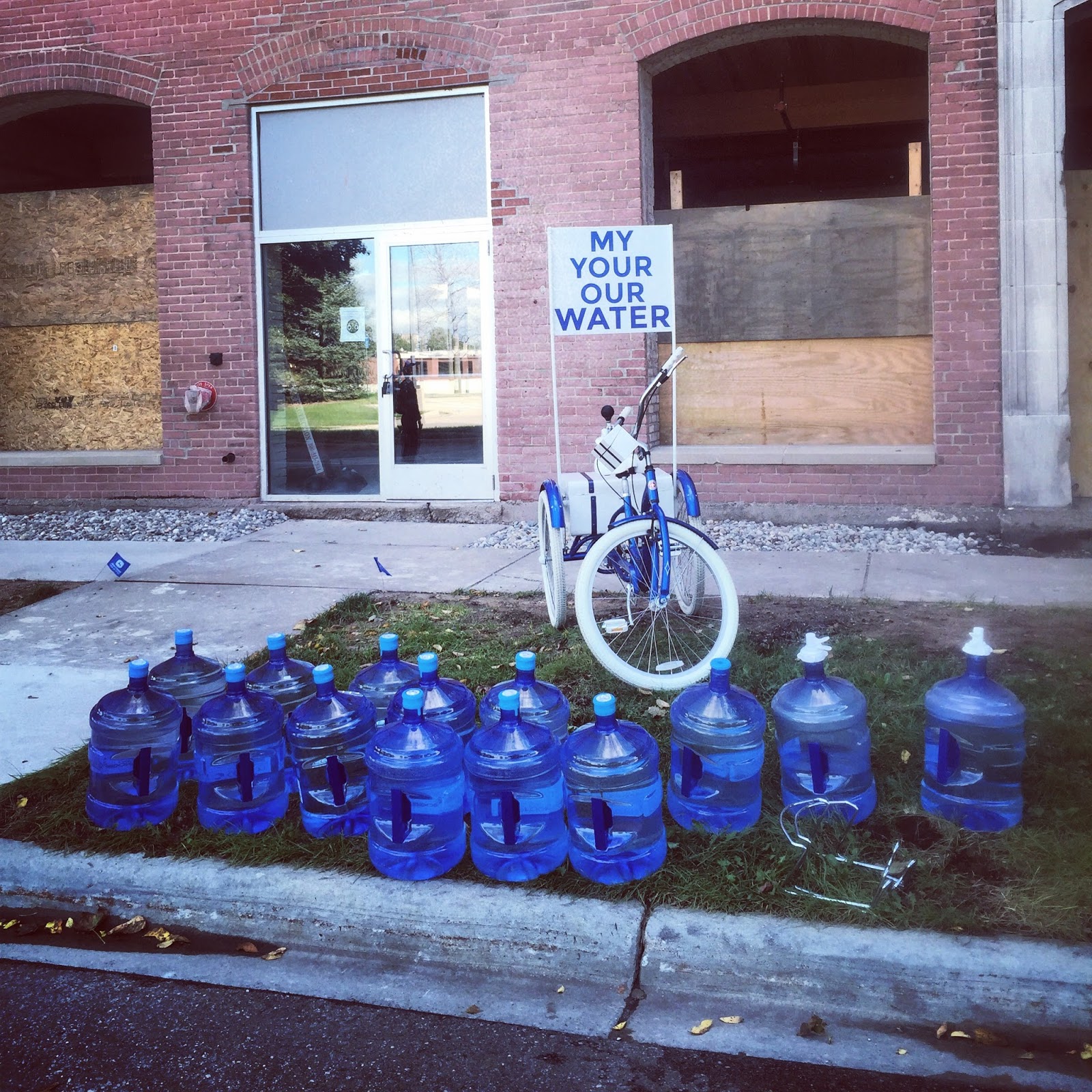
One last image submitted by a resident of Michigan of My Your Our Water in the Grand River in Grand Rapids, Michigan. This image was submitted to the blog by a first year graphic design student at Grand Valley State University in Michigan. Thank You for taking the time to watch us bob and float in your river.

This image was shared by Becky O from Allendale, Michigan.


Wednesday, October 28, 2015


 Irrigation 

Irrigation is the artificial distribution of water to an area of land most often for agricultural purposes and landscape maintenance during periods of inadequate rainfall or in arid regions.  Irrigation has been a vital component of civilization and central feature of agriculture for over 5000 years.
This image was submitted from New Mexico

Tuesday, October 27, 2015


Reflecting on a River 

Artist: Catherine Magel

"Reflecting on a River  began with the goal of reconnecting community to the natural environment and rebuilding an identity of St. Louis as a River city. A 240 foot -long, permanent public art installation, graces the downtown St. Louis flood wall with its celebration of the rich natural history of the Mississippi River. Through brilliant color, light-altering textures and sheer size, the sculptured ceramic mural interprets diverse flora and fauna, from microscopic life and native fish to land species of earth, sky, day, and night. Insects, fossils, and migrating birds and butterflies appear as colorful abstractions as well as nature studies.
The mural was commissioned by the partner Organizations of the Confluence Greenway Project, a conservation, heritage and recreation corridor being developed in the heart of the Bi-state metropolitan area. The mural welcomes visitors to the southern portion of the Greenway, at the downtown entrance to the St. louis Riverfront Trail. As it parallels the Mississippi River, the mural rolls across the floodwall in "waves" ranging from five to seven feet in height. Individual tiles weigh from three to fourteen pounds. More than 17,000 pounds of clay were used in the mural. Courtesy of the St. Louis Regional Arts 
Commission."


My Your Our Water visited  Reflecting on a River in September of 2015 while at the Mississippi River.

Monday, October 26, 2015


70 Gallons of Water on the Lawn

Number Crunch
The average american home uses 320 gallons of water a day.
Approximately 30 % of that is outdoor water usage. ( 96 gallons)
More than 50% of that outdoor water usage is for watering lawns or gardens.( <48 gallons)
As much as 50% of that water is wasted from inefficient watering methods. (<24 gallons)

Nationwide, landscape irrigation is estimated to account for nearly one-third of all 
residential water use, totaling nearly 9 billion gallons per day.


Sunday, October 25, 2015

Water Tanks

The storage of portable water has always be of importance to the development of civilization. The ability to store clean water for future use allows people to settle and homestead areas that may not have had ready access to water and or prepare for times of possible water need. The basic premise has always been to store clean water up in the air to then use gravity to deliver the water when needed. What began as small storage tanks has transformed into huge structures that tower hundreds of feet in the air holding millions of gallons of water for a given city. 


Saturday, October 24, 2015


Water Spot.

Believe it or not, there is a "water spot" in Newport, California. You can roll up and fill up your water jugs with honest to goodness "ph balanced water." If that sounds like too much work, don't worry, they also deliver. The water will arrive at your home or office or studio in a glass jugs with a monthly price tag ranging from $75-$125.

This image was submitted by Mary S. in southern California.


Friday, October 23, 2015


Bloomfield Orchard 

Bloomfield Orchard is located in Brentwood, California which is north east of San Francisco.  A Drought emergency has been declared and an immediate and mandatory 35% potable water reduction has been implemented.  The city of Brentwood has a drought and water conservation webpage that helps better understand the new rules in place and the water conservation goals the city is looking to achieve. The reduction of water usage is incentivized through rebates and penalties for non compliance. 

Thursday, October 22, 2015

Coke VS  Pepsi

The decades old cola war has now shifted advertising dollars into a new beverage market fight.  Aquafina- owned by Pepsi, is the No.1  bottled water with Coca-Cola's Dasani in a close No.2 spot. Today, water is a 3.5 billion market and everyone wants a drop of it.
"Figuring out how to turn the world's most ubiquitous thing into something distinctive and lucrative is suddenly a big battle in the beverage wars.Pepsi executives regularly debate whether they should divert marketing dollars from cola. Bottled water makes up less than 10% of either company's U.S. beverage sales. But nationwide bottled-water sales grew 30% last year, compared with 0.6% for soft drinks. Coke and Pepsi, in other words, now see water as their single biggest growth opportunity."

Wednesday, October 21, 2015


St. Louis Water Division

The St. Louis Water Division website states, "While St. Louisans currently do not have to worry about a water shortage, it is important to remember that water is a limited resource. There is the same amount of water on Earth today as there was 3 billion years ago, and only 1% of Earth's water is available for human consumption. Making the effort to conserve water now can help to avoid water shortages in the future."
 
1764:The City of St. Louis is founded.
1831: The City of St. Louis contracts with Abraham Fox and John Wilson to build a waterworks.
1835:
The City of St. Louis buys out the bankrupt Fox and Wilson, becoming sole owner of the St. Louis Waterworks.
1876: The position of Water Commissioner is created.
1900: The first experiments using lime and ferrous sulfate as water purifiers are conducted.
1904: The Water Division begins adding milk of lime and ferrous sulfate to purify the water.
1919: The Water Division begins using chlorine in the water purification process.
1923: Construction begins on the Howard Bend Plant and Stacy Park Reservoir.
1953: The Water Division begins adding fluoride to the treated water.
1965: The Water Division begins using activated carbon in the water purification process.
1995: A $19 million renovation begins on the Compton Hill Reservoir.
1999:Construction is completed on new chlorine handling facilities at both plants. 
2007: St. Louis City Water voted "Best Tasting Tap Water in the Nation" by the US Conference of Mayors.